



Many parents, teens, and adults wonder whether what they’re noticing is “just a phase” or something that deserves a closer look. An autism evaluation isn’t about labeling someone as broken. It’s about understanding how a person’s brain works so they can get the right support.
Autism spectrum disorder can be identified in children as young as 18 months, yet many children, teens, and adults in Texas are only now seeking answers. According to the CDC’s 2022 ADDM Network data, roughly 1 in 31 eight-year-old children in the U.S. have been identified with autism spectrum disorder ASD. Early screening can influence future outcomes for autistic individuals, and early diagnosis improves long-term outcomes for autistic children.
Noticing signs and asking for help is a strength. Texas Counseling Center offers child and adult autism evaluations in-person across the Houston and Dallas metro areas, plus telehealth options across the state. The rest of this article walks through common signs, how the autism evaluation process works, and what to expect.

Common Signs You May Need an Autism Evaluation
Autism spectrum disorder has a wide range of presentations. Signs can be subtle, especially in girls, women, and people who mask. Here are the red flags organized by age.
Young Children and Autism in Toddlers (18–36 Months)
- Limited or inconsistent eye contact; rarely looking when their name is called by 12–18 months
- Delayed speech (no single words by 16 months; no two-word phrases by 24 months), falling behind typical developmental milestones
- Limited pointing, gesturing, or showing objects to share interest
- Repetitive movements like flapping hands, rocking, or spinning objects; repetitive play such as lining up toys
- Intense distress with small changes in routines (route to daycare, order of activities)
- Strong reactions to sounds, textures, or lights-covering ears, refusing certain clothes
Children can be evaluated for autism as young as 18 months, and younger children who receive early intervention services show significantly enhanced developmental progress.
School-Age Children and Teens
- Struggles with back-and-forth conversation or making and keeping friends
- Intense, focused interests (trains, gaming, anime, history) that dominate conversations
- Literal thinking and difficulty understanding sarcasm, jokes, or hidden social rules
- Meltdowns or shutdowns after school due to social and sensory overload
- Being seen as “rude,” “bossy,” or “odd” despite trying hard
- History of bullying or social exclusion because of social differences
Adults
- Lifelong sense of feeling “different” or not fitting in, even when masking well
- Exhaustion from social interactions and needing long recovery time afterward
- Strong preference for routine, predictability, and doing things “the right way”
- Sensory sensitivities (noise, light, fabrics, crowded environments) affecting daily functioning or work
- Difficulty reading between the lines in conversations, office politics, or dating
- History of misdiagnoses such as anxiety, depression, or personality disorders that never fully explained lifelong experiences
Having several of these signs does not equal an automatic autism diagnosis, but it is a strong reason to consider a comprehensive evaluation.

When Autism Signs Are Easy to Miss
Not everyone who is autistic “looks” autistic. Masking-also called camouflaging-is the process of copying other people’s social behaviors, rehearsing conversations, using scripts to fit in, and hiding stims. Research using the Camouflaging Autistic Traits Questionnaire shows that females score significantly higher on masking and compensation subscales, which contributes to later or missed diagnosis.
Key reasons signs get overlooked:
- Girls, women, and AFAB individuals may be more socially motivated but still find interactions confusing or draining
- High academic achievement or strong verbal skills can hide social and sensory challenges
- Cultural factors and family expectations may normalize certain communication styles, delaying recognition
- Co-occurring conditions like ADHD, anxiety, or depression can overshadow autism signs-ADHD alone co-occurs in roughly 40% of individuals with autism
Consider a high-performing teen in Dallas who excels academically but melts down at home from social overload. Her child’s doctor may attribute the behavioral challenges to anxiety or stress, missing the underlying autism because she masks so effectively at school.
If you consistently feel overwhelmed by everyday expectations, or others tell you you’re “too sensitive” or “too rigid,” an autism evaluation may be worth pursuing.
What an Autism Evaluation Actually Looks Like
Understanding the autism evaluation process removes a lot of the uncertainty. Here’s what typically happens.
Screening vs. full evaluation:
- Autism screening uses brief questionnaires and developmental screening tools to flag risk. Developmental screening is often the first step in the evaluation process. A referral to a specialist is required if screening indicates concerns.
- A full autism diagnostic evaluation is a multi-hour, multi-component comprehensive assessment. Evaluations may be conducted by a team of professionals from different specialties.
Child’s Autism Evaluation Components
- Developmental and medical history: In-depth parent interviews are crucial for gathering the child’s developmental history-covering pregnancy, birth, milestones, child’s behavior, medical issues, and family history.
- Autism screening tools: The M-CHAT-R/F is a 20-question screening tool for toddlers. The SACS-R identifies autism behaviors in children from 12 months. The CAST is a 37-question tool for children ages 4 to 11. These are standardized tools that flag risk, not stand-alone diagnoses.
- Direct behavioral observation: The Autism Diagnostic Observation Schedule (ADOS-2) is the gold standard assessment tool for autism diagnosis. Observations during the evaluation assess social communication and behavior through play-based activities that feel like games for the child.
- Cognitive and developmental testing to understand the child’s strengths, processing speed, fine motor skills, and learning profile
- Speech and language evaluation with a speech language pathologist focusing on expressive, receptive, and social communication skills
- Occupational or sensory screening with an occupational therapist when needed, to explore sensory processing and daily living skills
Adult Autism Evaluation Components
- Detailed clinical interview covering childhood, school experiences, relationships, work history, and mental health background
- The Autism Spectrum Quotient Test has 50 questions for ages 16+ and is used alongside other self-report autism screening tools as part of data gathering
- Behavioral observation during conversation, problem-solving, and social scenarios
- Collateral information from a parent, partner, or other caregivers who know the person well, especially about childhood behavior
The evaluation process is tailored to the individual’s child’s age and support needs. Only qualified professionals-licensed psychologists, a developmental pediatrician, psychiatrists, or child psychologists-can diagnose autism and provide a formal autism diagnosis. Specialists may include developmental pediatricians and child psychologists working as a team.
At Texas Counseling Center, evaluations can be done in-person at Houston or Dallas offices or via secure telehealth, depending on clinical needs.

Key Areas Professionals Assess for Autism Spectrum Disorder
Clinicians evaluate several domains, drawing on criteria from the Diagnostic and Statistical Manual (DSM-5). Diagnostic criteria for autism involve persistent social communication differences and restrictive behaviors.
- Social communication: Back-and-forth conversation, small talk, sharing interests; understanding facial expressions, tone of voice, personal space; ability to develop age-appropriate relationships
- Restricted and repetitive behaviors: Repetitive movements (stimming), speech patterns, or routines; strong need for sameness; focused, intense interests that are highly specialized
- Sensory processing: Over- or under-responsiveness to sounds, textures, lights, smells, or movement; sensory-seeking behaviors like spinning or seeking pressure
- Functional impact: How these differences affect school services, work, relationships, daily living skills, and emotional health
Clinicians also consider differential diagnosis. This means distinguishing autism spectrum disorder from ADHD, social anxiety, language disorders, intellectual disability, and trauma-related conditions. When overlapping concerns exist, ADHD testing or additional testing may be recommended-including learning disability evaluations, psychiatric assessment, or medical and genetic testing. There is no blood test for autism; a diagnosis is based on the full picture-developmental history, observed behavior, standardized tools, and how long signs have been present.
What to Expect Before, During, and After Your Autism Evaluation
Before the Evaluation
- You may be asked to complete questionnaires and provide school records, past evaluations, and medical records. Parents must complete forms before their child is added to the waiting list.
- Preparing for an evaluation involves gathering detailed information about the child’s behaviors and history. Keep notes or short videos of behaviors that concern you.
- Check insurance coverage early. Texas Counseling Center accepts many commercial plans and can verify benefits.
- Waiting times for autism evaluations can range from several weeks to several months. Children younger than 3 often receive appointment priority for evaluations. The evaluation process can take 4-8 weeks from referral to report.
During the Evaluation
- An autism evaluation typically takes 2 to 4 hours, sometimes spread over multiple visits. Evaluations typically last between 1.5 to 4 hours depending on child’s age and needs.
- For most children, the visit feels like structured play. For older children, teens, and adults, it feels like an in-depth guided conversation plus some tasks.
- There is no “pass or fail.” The evaluation process includes developmental history and behavioral observation to understand how the person’s brain works, assessing the child’s response to social and sensory situations.
After the Evaluation
- Feedback sessions provide results and recommendations after evaluations, usually within 1–4 weeks. Clinicians review results with families and answer questions.
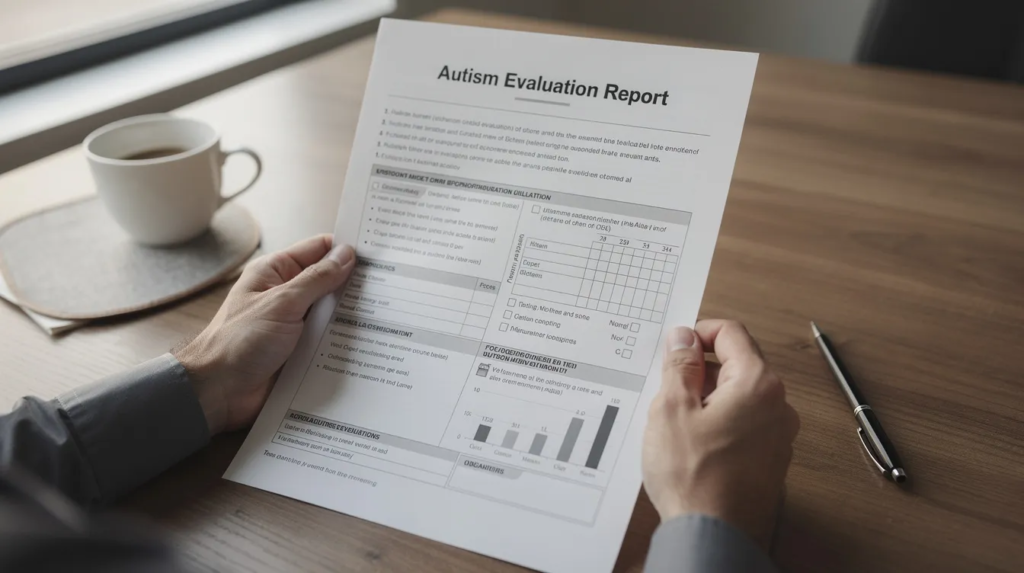
- You receive a written report summarizing the child’s developmental and medical history, test results, impressions, diagnosis (if the child meets criteria), and the child’s strengths alongside challenges.
- A diagnosis is often required to access support services. This report can be used for school services, workplace accommodations, therapy referrals, and community supports in Texas.
What to bring:
- Completed questionnaires, previous testing reports, IEP/504 plans, medication lists, and a list of questions
It’s normal to feel emotional-relief, grief, validation. Texas Counseling Center offers ongoing counseling, teen therapy, and family support as follow up care after diagnosis.
How Texas Counseling Center Can Help (Houston, Dallas, and Telehealth)
Texas Counseling Center offers:
- Comprehensive autism testing for children, teens, and adults in Texas
- Related evaluations like ADHD evaluations when there are overlapping concerns
- Counseling for anxiety, depression, trauma, and relationship issues that often accompany a new autism diagnosis
- Teen therapy, EMDR therapy, and medication management as part of a broader mental health support plan
Both in-person appointments in greater Houston and Dallas and secure telehealth services are available across Texas. The team includes licensed therapists and psychologists experienced in autism spectrum disorder ASD, developmental and medical history review, and autism-specific assessment tools like the Childhood Autism Rating Scale and ADOS-2.
Why a mental health clinic matters for autism diagnostic evaluations:
- Easier transition from diagnosis to ongoing therapy or skills work
- One integrated team that can coordinate counseling, diagnostic evaluations, and medication management
Early intervention significantly enhances developmental progress. The sooner a child receives a comprehensive evaluation and the right support, the better the long-term outcomes for the child’s development.
When to Reach Out for an Evaluation
- You notice multiple signs in yourself or your child matching the lists above
- Your child’s daycare, teacher, or child’s healthcare provider has suggested an autism screening or developmental evaluation and raised developmental concerns
- You’ve had multiple mental health diagnoses addressing behavioral disorders or mental disorders that never fully explained your lifelong experiences
- Everyday tasks, social situations, or sensory environments feel consistently harder for you than for many children or adults around you
You do not need to be “sure” it is autism to reach out. Wondering and wanting clarity is enough reason to seek a medical professional opinion. Whether you’re exploring a modified checklist result that flagged high risk or have noticed developmental delays for several weeks, a thorough assessment can identify children and adults who would benefit from support.
Ready to take the next step? Contact Texas Counseling Center to schedule a consultation. Whether you’re in Houston, Dallas, Austin, or anywhere in Texas, our team is here to help you find answers and a clear path forward.
Share