



If you’re a Texas parent searching for answers about social media and teen mental health, you’re in the right place. This article is written for families navigating the complicated intersection of youth mental health, adolescent mental health, and social media use – with a focus on what matters most right here in Texas. Texas Counseling Center serves families across Houston, Dallas, and all of Texas through in-person and telehealth therapy, and we created this guide to give you the information and tools you need right now.
Introduction: Why Social Media and Teen Mental Health Matter in Texas Right Now
The numbers paint a concerning picture. According to 2023 CDC data, about 40% of U.S. high school students reported persistent feelings of sadness or hopelessness, and roughly 20% seriously considered suicide. At the same time, approximately 95% of teens aged 13 to 17 use social media platforms, and social media has a profound impact on teenage mental health. For Texas families, these aren’t just national headlines – they’re unfolding in living rooms, classrooms, and group chats across Houston, Dallas, Austin, and San Antonio every day.
It’s no surprise that 55% of parents are extremely concerned about teen mental health, and 44% of parents say social media negatively impacts teens. These worries aren’t unfounded. The surgeon general’s advisory issued in 2023 warned that adolescents spending more than three hours a day on social media face roughly double the risk of anxiety and depression symptoms. Yet social media isn’t only a source of harm – it can also support connection, creativity, and access to mental health resources when used thoughtfully.
This article will walk you through social media’s impact on teen mental health, the warning signs parents should watch for, and the immediate steps you can take to protect your child’s mental health. We’ll also cover when it’s time to reach out for professional help and how Texas Counseling Center can support your family through teen therapy, ADHD and autism evaluations, EMDR, and telehealth services.

How Much Are Teens Really Using Social Media?
The short answer: a lot. A 2023 Pew Research Center survey found that roughly 95% of U.S. teens aged 13 to 17 use at least one social media platform, and about one-third say they are on social media “almost constantly.” Texas teens mirror these national patterns, especially in urban and suburban areas.
Here’s what the data tells us about teen social media use:
- YouTube is the most widely used platform (~90%+ of teens), followed by TikTok (~63%), Snapchat (~60%), and Instagram (~59%)
- About 77% of high school students use social media several times a day
- 45% of teens say social media hurts their sleep quality
- 22% of teens say social media hurts their grades
- Active social media usage – posting, commenting, messaging – differs from passive usage like scrolling in its emotional impacts, with passive use linked more strongly to social anxiety and depressive symptoms
The critical threshold appears to be around three hours per day. A 2026 longitudinal study of approximately 28,000 adolescents found that those using social media more than three hours daily had about 2.5 times the odds of developing major depressive disorder compared to those using under one hour.

Social Media’s Impact on Teen Mental Health: Risks and Red Flags
Understanding the risks doesn’t mean demonizing every app on your teen’s phone. It means knowing what to look for so you can respond early.
The most well-documented risks include heightened anxiety and depression, body image disturbances and eating disorders, cyberbullying, sleep disruption, and exposure to self harm content. Teens can be exposed to unrealistic body images through social media, and constant exposure to idealized content on social media contributes to low self-esteem – particularly on visual platforms like Instagram and TikTok, where filters distort reality. Cyberbullying on social media can lead to feelings of isolation, and late-night social media use can disrupt circadian rhythms and worsen mental health. High levels of social media use are correlated with increased anxiety and depression, and excessive use of social media is linked to chronic sleep issues in teens. The teenage brain is sensitive to social rewards and punishments from social media, which can lead to addiction-like behaviors. Frequent social media use is associated with changes in brain development, and social media can create stress through public postings that lead to regret. Excessive screen time is linked to poor sleep quality, and excessive social media usage can disrupt healthy behaviors like sleep. Consider harmful patterns like doomscrolling past midnight, following “thinspo” or extreme fitness influencers, compulsively checking for likes, or enduring harassment in group chats – all of which can make teens feel worse about themselves.
That said, social media isn’t all negative. For socially isolated or marginalized young people – including LGBTQ+ youth, teens in rural areas, or those with disabilities – online communities can provide genuine emotional support. Platforms allow self-expression, creativity, and access to mental health information. But for vulnerable adolescents, the risks tend to outweigh these benefits without active parental guidance and supportive environments.
Common Mental Health Conditions Linked With Problematic Social Media Use
When social media use becomes problematic – interfering with sleep, mood, school, or relationships – it can trigger or amplify a range of mental health conditions. It’s important to understand that heavy social media use rarely “causes” these disorders on its own, but it acts as an accelerant for existing vulnerabilities during adolescence.
Anxiety and depression are the most commonly linked conditions. About 9.5% of teens experience anxiety that interferes with daily life, and 4.5% of teens live with depression. Endless social comparison, negative experiences in comment sections, and the pressure to curate a perfect online persona can worsen low mood, irritability, and persistent worry. But for vulnerable adolescents, the effects are not uniform: some teens find real connection and support online, while others – depending on their social environment or existing stressors – face a higher risk of harm. Research shows these symptoms climb significantly once social media use exceeds about three hours per day. If your teen is struggling with these symptoms, depression and anxiety counseling can provide structured support.
Eating disorders including anorexia nervosa and bulimia nervosa are fueled by image-focused platforms. Exposure to idealized images on social media can cause low self-esteem, body dissatisfaction, restrictive eating, bingeing, and purging. The surgeon general’s advisory noted that nearly half of teens said social media makes them feel worse about their bodies. While these disorders are more prevalent among teen girls, boys are affected too, particularly around muscular ideals.
Self-harm and suicidal thoughts can be normalized when teens encounter romanticized or graphic content online. Exposure to self-harm imagery can lower the threshold for dangerous behaviors, particularly in young people already dealing with depression or trauma.
ADHD and autism also intersect with problematic social media use. Nearly 10% of U.S. kids aged 3 to 17 have ADHD, and these teens often display higher impulsivity – more screen switching, more frequent checking, less ability to disengage. Autistic teens may struggle with misreading social cues online or feeling overwhelmed by unpredictable interactions. An ADHD evaluation can help determine if neurodevelopmental factors are contributing to your teen’s struggles.
Additionally, 17% of high school students report using street drugs, and heavy screen time overlaps with substance use and behavioral problems in adolescent health research, often mediated by irregular sleep and decreased physical activity.
Warning Signs Your Teen’s Social Media Use Is Hurting Their Mental Health
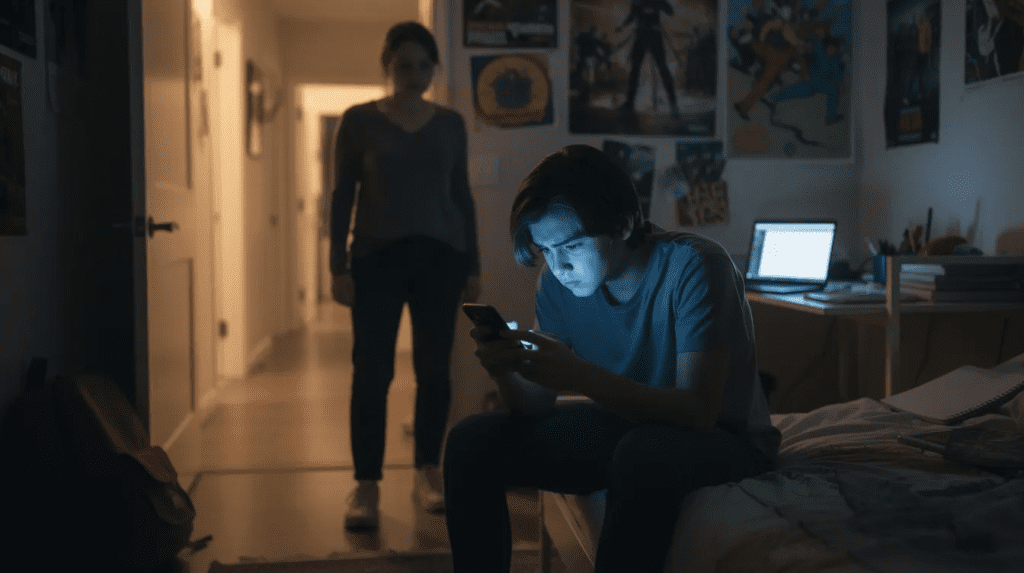
Parents don’t need to monitor every post, but knowing the warning signs can make the difference between early intervention and a crisis. Watch for these patterns:
- Sleep changes: Staying up late scrolling, difficulty falling asleep, chronic daytime fatigue
- Academic decline: Grades dropping, missing deadlines, inability to focus – 22% of teens cite social media as a main mental health factor, and 8% of teens cite pressures and expectations as a mental health factor
- Social withdrawal: Giving up hobbies, avoiding in-person time with friends, spending all free time online
- Emotional red flags: Intense mood swings after being online, anxiety about posts or likes, visible distress after checking their phone
- Physical symptoms: Rapid weight change, frequent headaches or stomachaches, persistent fatigue
- Direct danger signs: Searching for self-harm or suicide content, posting about wanting to die, giving away possessions, or sudden calm after a period of deep distress
If you notice any direct danger signs, don’t wait. Call 988 (the Suicide and Crisis Lifeline) or take your teen to the nearest emergency room immediately.
Texas-Specific Pressures on Teens: Beyond Social Media
Social media doesn’t exist in a vacuum. Texas teens face a range of stressors that can compound the negative effects of online life. Academic pressures in Texas high schools – competitive college admissions, UIL activities, extracurricular overload, and part-time jobs – weigh heavily on students. In some families, economic strain, immigration-related worries, discrimination, or rural isolation add another layer of stress. About 19% of teens report social media negatively impacts their mental health, but those numbers climb when real-world stressors stack up.
In 2023, roughly 42% of Texas high school students reported feeling sad or hopeless for two or more weeks, and rates of major depressive episodes among Texas youth rose from about 12% to 19% over recent years. Many Texas counties are designated mental health workforce shortage areas, meaning even when families seek help, providers may be hard to find – especially in rural and border regions.
Social media amplifies these pressures by placing them on a public stage. Grades, body image, popularity, and politics are all visible and “ranked” online. Understanding this bigger picture helps parents respond with empathy rather than simply policing devices. Poor mental health in teens is rarely about one single factor.
Healthy Social Media Guidelines for Texas Families
You don’t need to ban every app – but you do need a plan. Here are practical guidelines for your family:
- Delay access thoughtfully: Hold off on certain social media sites until at least age 13, and consider waiting longer for platforms with heavy visual or algorithmic content
- Set screen time boundaries: Aim for under two to three hours of recreational social media use on school days, given that exceeding three hours doubles mental health risks
- Create device-free zones: Keep phones out of bedrooms at night and off the dinner table; charge devices in a common area
- Co-create a family media plan: Sit down together and draft guidelines using tools like the American Academy of Pediatrics’ Family Media Plan – teens are more likely to follow rules they helped create
- Model the behavior: Limit your own scrolling, avoid texting while driving, and demonstrate healthy ways to unplug; children learn digital habits from the adults around them
How to Talk With Your Teen About Social Media and Mental Health
Here’s the reality: 80% of parents feel comfortable discussing mental health with teens, and 84% of mothers are comfortable doing so. But only 52% of teens feel comfortable discussing their mental health with parents, and only 35% of teens share the same concern about mental health that their parents do. That gap matters. Only 12% of teens are comfortable discussing mental health with teachers, which means you – the parent – may be the most trusted person in the room, even when it doesn’t feel that way.
Start with curiosity, not lectures. Ask questions like “What do you like most about TikTok?” or “Has anything online ever made you feel stressed?” Recommend asking about both the positives (connection, creativity) and the negatives (bullying, pressure to look perfect, fear of missing out). Use real examples from news stories or public figures – without shaming – to open discussions about body image, online drama, or harmful content.
The most important strategy: listen more than you talk. Avoid reacting with shock when your teen shares something uncomfortable. Thank them for being honest. That trust is the foundation for every conversation that follows.
When Is It Time to Seek Professional Help?
You don’t have to figure this out alone. If you’re noticing lasting changes – more than two weeks – in your teen’s mood, behavior, sleep, or appetite, it’s time to consider an evaluation. A mental health professional can assess for depression, anxiety, eating disorders, ADHD, trauma, and other adolescent mental health conditions that may be interacting with social media use.
Urgent situations require immediate steps: if your teen talks about suicide, engages in self-harm, withdraws completely, or exhibits sudden risky behavior, call 988 (the crisis lifeline) right away or go to the nearest emergency room.
At Texas Counseling Center, licensed therapists and psychiatric providers work with teens and parents to create personalized treatment plans – including therapy, medication management when appropriate, and guidance around social media habits. Telehealth counseling is available for families anywhere in Texas who may not have local access to adolescent psychiatry or specialized care.
How Texas Counseling Center Supports Teens and Parents
Texas Counseling Center offers teen therapy in-person at our greater Houston and Dallas offices and via telehealth across Texas. We treat anxiety, depression, social anxiety, self-harm, bullying-related trauma, and the mental health concerns that often accompany heavy social media use. Social media provides access to health information that can help struggling teens, and 63% of teens use social media for mental health information – but professional support goes deeper.
Our team provides specialized evaluations including ADHD testing and autism assessments, forensic and immigration evaluations, and evidence-based treatments like CBT, EMDR for trauma, and medication management. These approaches address the underlying mental health problems that make social media more harmful – not just the screen time itself.
We work with many insurance plans and can help parents navigate the process of getting support quickly. Whether your teen needs a full evaluation or you simply want guidance as a parent, we’re here to help.
Practical Steps Parents Can Take This Week
You don’t have to overhaul everything overnight. Here are realistic actions for the next seven days:
- Do a social media audit together: Sit with your teen, review followed accounts, mute or unfollow harmful ones, and add positive, supportive content. Remember that 74% of teens feel more connected through social media, and social media can serve as a platform for self-expression and creativity. Social media can offer ways to maintain friendships for marginalized youth. The goal isn’t elimination – it’s curation.
- Schedule one device-free family activity: A walk, game night, or shared meal without screens. Physical activity and face-to-face time are proven buffers against stress and poor mental health.
- Set a “digital sunset”: Choose a consistent time – for example, 9:30 p.m. – when phones are charged in a common area, not bedrooms, to protect sleep and well being.
- Have one open conversation: Use the strategies above to check in with your teen about what they’re seeing and feeling online.
- Schedule a consultation: If anything from this article raised concerns, reach out to Texas Counseling Center – online or in person – to discuss your options.
Conclusion: Balancing Connection and Protection in a Digital Texas
Social media is part of modern teen life, and it isn’t disappearing anytime soon. Whether it supports or strains teen mental health depends on how it’s used, how much it’s used, and whether young adults and teenagers have the guidance and support they need from family, school, and community. Gender differences, age group, and individual mental health conditions all shape how each person experiences these platforms – there’s no one-size-fits-all answer.
What matters most is this: noticing a problem is the first step. Parents, educators, and mental health professionals can work together to create supportive environments that promote healthy digital habits and emotional resilience. Help – from Texas Counseling Center and from resources like the CDC’s youth mental health data and health and human services advisories – is available, accessible, and effective. You don’t have to navigate this alone.
Share
Recent Posts