



Anxiety disorders are among the most common mental health conditions in the United States. According to the National Institute of Mental Health, about 19.1% of U.S. adults experience an anxiety disorder in any given year, and girls and women are more likely to experience anxiety disorders than boys and men. Many different anxiety disorders exist, yet fewer than half of those affected receive adequate treatment.
Cognitive behavioral therapy is one of the most effective treatments available. CBT is a structured, goal-oriented psychotherapy that helps change negative thought patterns and behaviors fueling anxiety. At Texas Counseling Center, licensed therapists provide therapy CBT for anxiety through in-person sessions in greater Houston and Dallas and via secure telehealth across Texas.
If the idea of a first session makes you feel anxious or feel trapped by uncertainty, that reaction is completely normal. Your privacy and comfort come first. This article covers what CBT is, how it works for anxiety, what happens in your first few sessions, and how to get started.

What Is Cognitive Behavioral Therapy (CBT)?
Cognitive Behavioral Therapy is a common psychotherapy type, sometimes called cognitive behavior therapy or cognitive therapy. It is a form of talk therapy built on several core principles: your thoughts, feelings, and behaviors are interconnected, and by changing unhelpful thoughts and unhelpful behavior, you can improve your emotional health.
CBT is one of the most researched psychological therapy approaches. It is recommended by the American Psychological Association and the World Health Organization as a first-line effective treatment for anxiety. CBT typically consists of short-term treatment lasting between 5 to 20 sessions, making it appealing for anyone seeking practical tools and measurable progress.
How CBT Works in the Brain and Daily Life
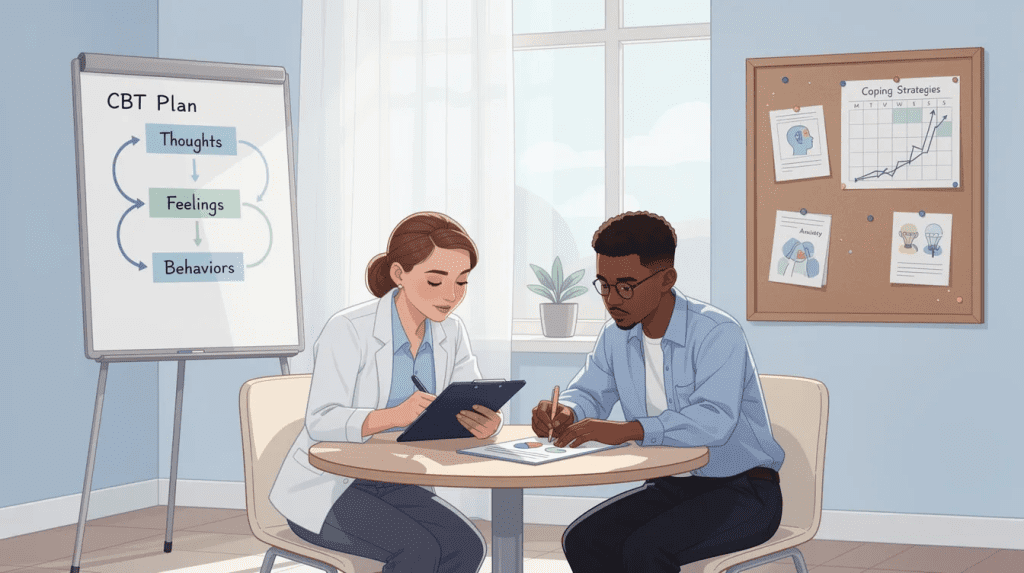
The core principles of CBT follow a clear model: a situation triggers automatic thoughts, which produce feelings like anxiety, which drive behaviors such as avoidance, which reinforce the cycle. CBT aims to interrupt this loop by helping you recognize and test thinking patterns that maintain distress.
- Unhelpful thoughts like “Everyone will judge me” in social situations lead to avoidance, which strengthens social phobia over time
- CBT helps you notice automatic negative thoughts, examine whether they reflect reality, and experiment with new behavior patterns
- Physical symptoms like a pounding heart, chest pain, heart palpitations, or trouble concentrating are addressed directly
- Anxiety can create a sense of impending danger or feeling weak, even in everyday situations that pose no actual threat
- The coping skills you build in CBT stay with you long after therapy ends, supporting long-term mental health
Conditions CBT Can Help With
CBT can treat a wide range of mental health conditions, not just anxiety. It is effective for treating depression, anxiety, stress, grief, and chronic pain. CBT is utilized to treat PTSD, anxiety disorders, and mood disorders. Conditions include:
- Generalized anxiety disorder, social anxiety disorder, panic disorder, and specific phobias
- Separation anxiety disorder, selective mutism, and health anxiety
- Depression, post traumatic stress disorder, and OCD
- Teen anxiety, work stress, and relationship conflicts
- Many mental health conditions involving emotional challenges, including eating disorders
- Chronic medical conditions where anxiety is a risk factor (e.g., chronic pain)
CBT can be combined with medication for better results. When a mental health professional determines that psychiatric medications would help, therapists coordinate with prescribers who can prescribe medications such as antidepressants, which are commonly used to treat anxiety disorders.

How CBT Helps with Anxiety Disorders
An anxiety disorder is more than occasional worry. Symptoms of anxiety disorders last for at least several months and interfere with daily life-disrupting work, relationships, sleep, and physical well-being. If left untreated, anxiety disorders can lead to depression and substance use disorders, including drug use. Effective treatments for anxiety include medications and cognitive behavioral therapy.
CBT targets the learned patterns of thinking and avoidance that keep anxiety alive. Whether you feel depressed alongside your anxiety or experience panic attacks during stressful situations, CBT addresses both the cognitive and behavioral sides. It is important to understand that anxiety tied to specific life events or an underlying health condition may also respond well to treatment.
Common CBT Techniques for Anxiety
Therapists at Texas Counseling Cente match CBT techniques to each person’s needs. Common approaches include:
- Cognitive restructuring: CBT identifies distorted thinking and utilizes cognitive restructuring techniques to challenge unhelpful patterns. You ask, “What’s the evidence? What’s a more balanced thought?”
- Behavioral experiments: Testing anxious predictions against real outcomes-such as attending a meeting and observing whether people actually stare
- Relaxation and grounding: Breathing exercises, progressive muscle relaxation, and mindfulness for stress management and calming negative emotions and negative feelings
- Worry scheduling: Separating hypothetical worries from real problems, building problem solving skills for actionable concerns
- Problem-Solving Therapy improves problem-solving skills for stressors, complementing other forms of CBT
CBT techniques teach people to replace unhelpful patterns with healthier responses to everyday challenges and everyday life.
Exposure Therapy: Safely Facing Your Fears
Exposure therapy is a specialized behavioral therapy technique where you face anxiety triggers in a planned, step-by-step way. CBT applies behavioral activation to face fears rather than avoiding them.
- For social anxiety, a hierarchy might start with saying hello to one coworker, then attending a small gathering, then giving a short presentation
- Exposure is collaborative and paced-never forced. Your therapist helps you feel challenged but safe
- Prolonged Exposure Therapy helps confront past traumatic events, particularly in PTSD treatment
- Research shows exposure therapy is among the most effective ways to reduce long-term anxiety and panic attacks
- Physical health conditions and any medical condition are always considered before designing exposures

What to Expect in Your First CBT Sessions for Anxiety
The first one to three sessions focus on assessment, understanding your anxiety, and building a treatment plan. It is completely normal not to know what to say. At Texas Counseling Center, sessions happen in person at Houston and Dallas offices or via secure telehealth video for Texas residents.
Your First CBT Session: Assessment and Getting to Know You
- Your therapist helps by asking about current symptoms, panic attacks, past mental health history, medications, and family history
- Standardized tools like the GAD-7 and PHQ-9 help quantify severity of anxiety and depression
- You will discuss how anxiety affects work, school, relationships, sleep, and physical health
- This is your chance to share goals-whether that means driving again, speaking in meetings, or reducing health anxiety
- Some topics may feel emotional. You can pause anytime; the therapist works at your comfort level
- If relevant, services like medication management, ADHD evaluation, or trauma counseling may be discussed
- If you experience suicidal thoughts, your therapist will address safety planning with care
Session Two and Three: Forming a CBT Treatment Plan
- Your therapist shares a personalized “case formulation”-a map of how your thoughts, feelings, and behaviors interact
- Goals become specific: “Drive on the freeway twice a week” or “Attend one social event monthly”
- The CBT model is explained using diagrams or worksheets
- First techniques are introduced: tracking unhelpful thoughts, monitoring anxiety levels, and simple breathing exercises
- You agree on session frequency (often weekly) and expected length of therapy-for many, 8 to 16 sessions

Homework and Practice Between Sessions
CBT encourages practicing new skills through homework assignments outside of therapy. This is not schoolwork-it is practical application designed to help skills stick in real life.
- Examples: keeping an anxiety log, filling out thought records, trying one small exposure step, or practicing relaxation daily
- It is okay if you do not complete everything perfectly. The point is learning, not perfection
- In telehealth sessions, homework can be shared via secure client portals
Does CBT Really Work for Anxiety? Evidence, Benefits, and Limits
Numerous studies show that CBT is effective for various mental health conditions. Meta-analyses report that roughly 48–55% of adults with anxiety disorders reach remission after completing CBT, with relapse rates between 0% and 14% in follow-up studies. Most people start feeling better within a few months of CBT.
Typical benefits include fewer panic attacks, less avoidance, improved sleep, better concentration, and more confidence in everyday situations. CBT helps in long-term relapse prevention by equipping individuals with coping strategies that persist after treatment ends.
CBT is not a quick fix. It may feel uncomfortable during exposure or when confronting painful psychological problems. For severe anxiety or mental illness such as bipolar disorder, medication and other therapies may be needed alongside CBT. Other approaches exist: Acceptance and Commitment Therapy focuses on accepting unwanted thoughts, while Dialectical Behavior Therapy combines acceptance and change strategies. Even when anxiety does not disappear entirely, CBT can dramatically improve quality of life.
Who Is a Good Candidate for CBT for Anxiety?
- People with generalized anxiety, social anxiety disorder, panic disorder, specific phobias, OCD, or PTSD symptoms
- Teens and college students facing performance pressure, test anxiety, or social pressures
- Busy adults seeking structured, time-limited therapy with concrete tools
- Clients willing to practice skills between sessions-they typically see faster results
- Neurodivergent clients (ADHD, autism) benefit from adapted pacing and tools
- Anyone dealing with psychological problems related to risk factors like difficult life events
CBT at Texas Counseling Center: In-Person and Telehealth in Texas
Texas Counseling Center provides CBT for anxiety disorders, depression, trauma, teen issues, and relationship distress. Licensed therapists are available at offices throughout greater Houston and Dallas, plus secure telehealth statewide for clients anywhere in Texas. CBT can also treat depression alongside anxiety.
Additional services include ADHD evaluation, adult autism testing, EMDR therapy, forensic and immigration evaluations, ESA letters, and medication management. Insurance is accepted for many plans, and staff can help verify benefits before you begin.
What Your First Appointment with Texas Counseling Center Looks Like
- Contact the clinic by phone or online form, then complete a brief intake call
- Fill out digital intake forms (consent, privacy, medical history) before your first visit
- Choose in-person at a Houston or Dallas office or a HIPAA-compliant telehealth video session
- Your first session focuses on listening to your story, clarifying goals, and answering questions about CBT and treatment options
- Bring any questions about CBT techniques, exposure therapy, or concerns about starting treatment
Conclusion
CBT is a proven, practical way to treat anxiety disorders by addressing the unhelpful thoughts and avoidance behaviors that keep you stuck. Starting the first session is often the hardest step, but it can be the turning point toward regaining control over your everyday life. You do not have to wait until symptoms become overwhelming to reach out for help-early intervention leads to stronger outcomes.
Share
Recent Posts