



Introduction: Why Emotional Support Animal Letters Matter in 2026
If you live with anxiety, depression, PTSD, or another mental health condition, you already know how much your daily environment affects your symptoms. For many Texans—especially in cities like Houston and Dallas—an emotional support animal provides the comfort and stability that makes daily life manageable.
But here’s the challenge: most apartments have no pet policies. That’s where an emotional support animal letter comes in. This document allows individuals to live with their emotional support animal in housing that typically prohibits pets, as mandated by the Fair Housing Act. It can also save you hundreds of dollars in pet rent and pet deposits each year.
Unfortunately, the internet is flooded with websites selling Valid ESA letter claiming “instant approval” services that leave tenants without support. At Texas Counseling Center, we provide legitimate ESA evaluations—in-person at our Houston and Dallas offices or via secure telehealth anywhere in Texas—because we believe mental health care should be thorough and ethical.
In this guide, you’ll learn exactly what an emotional support animal letter is, how to get one the right way, what rights it actually grants, and how to spot scams that could cost you your housing.

What Is an Emotional Support Animal Letter?
An ESA letter is a document issued by a licensed mental health professional that confirms a person’s need for an emotional support animal due to a qualifying mental health condition. It’s clinical documentation—not a pet license or registration card.
Emotional support animals (typically dogs or cats, though other domesticated animals qualify) provide substantial and measurable emotional support that can significantly improve mental health for individuals facing challenges such as anxiety, depression, and PTSD. Unlike service animals, they don’t need special training. Their presence alone delivers therapeutic benefits.
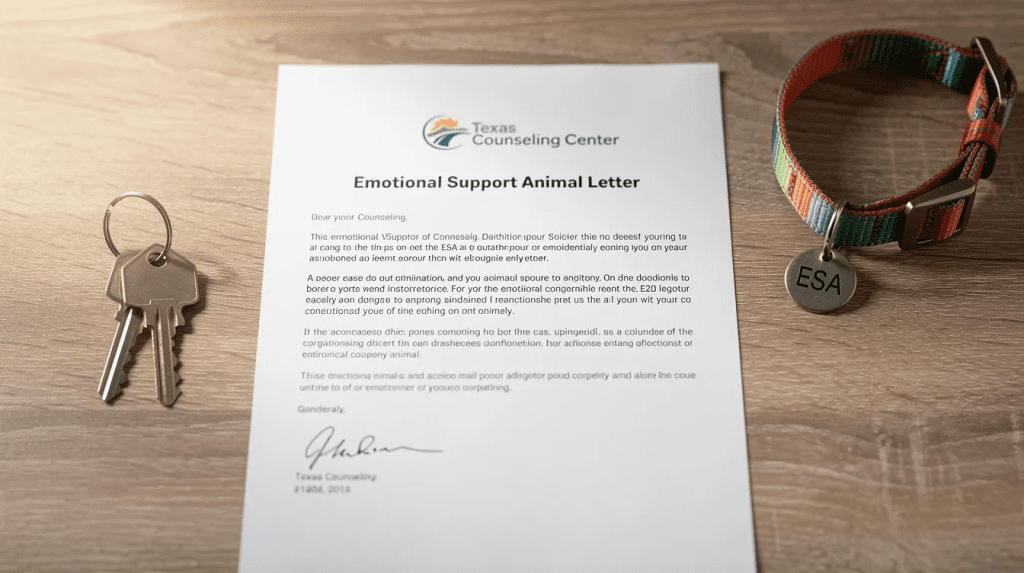
A valid ESA letter is usually one page on official letterhead. It includes your name, a statement confirming you have a mental or emotional disability that substantially limits one or more major life activities, a recommendation for the support animal as part of your treatment plan, and a reference to the Fair Housing Act. It protects your privacy by not naming your specific diagnosis.
At Texas Counseling Center, ESA letters are only issued after a proper evaluation with a licensed clinician in Texas.
ESA Letters vs. “ESA Certification” and Online Registries
Here’s something critical to understand: federal law does not recognize any official ESA certification, ID card, or registration. The only legitimate documentation for an emotional support animal is an ESA letter from a state-licensed mental health professional.
Those websites selling digital certificates, registry listings, or “official” ID cards? They’re not recognized by HUD, the Department of Justice, or any housing provider who knows the law. In 2023, one prominent site (ESAletter.com) was fined $1.2 million for deceptive practices. The FTC reported over 500,000 complaints related to ESA scams in 2026 alone.
Red flags include:
- Instant approval with no live evaluation
- Promises of public access rights for your emotional support animal
- “Lifetime” validity claims
- Providers who aren’t licensed mental health professionals
Housing providers typically ask for a legitimate ESA letter from a licensed professional—not a registration number from a website. Texas Counseling Center never sells registrations or ID cards. We focus only on clinically appropriate, compliant ESA letters.
How Emotional Support Animals Differ from Service Animals and Therapy Animals
Understanding these categories matters because they have different legal protections.
| Animal Type | Training Required | Legal Protections | Public Access |
| Emotional Support Animal | No formal training | Fair Housing Act (housing only) | No |
| Service Animal (ADA) | Specifically trained to perform tasks | Americans with Disabilities Act | Yes |
| Therapy Animal | Trained for comfort in group settings | None for individuals | No |
Service animals, as defined by the Americans with Disabilities Act, are specifically trained to perform tasks for individuals with disabilities—a psychiatric service dog might interrupt panic attacks or alert to PTSD episodes. Unlike service animals, emotional support animals are not trained to perform specific tasks; they primarily provide emotional comfort through companionship.
Therapy animals visit hospitals, schools, or nursing homes with their handlers but create no individual housing or public access rights.
Here’s a practical example: A Dallas veteran with post traumatic stress disorder might have an emotional support animal ESA at home that reduces hypervigilance and nightmares. But if they need a dog to perform tasks like alerting to flashbacks in a grocery store, they’d need a service dog with public access rights under the disabilities act.
Your ESA Housing Rights Under the Fair Housing Act
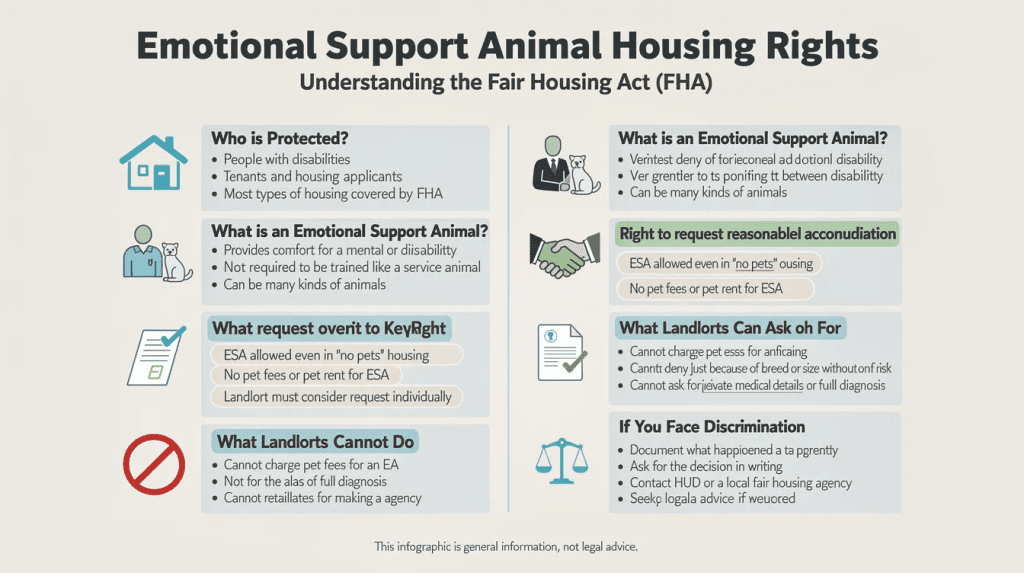
The Fair Housing Act entitles individuals with a valid ESA letter to reasonable accommodations in housing. This federal law applies across Texas and the entire U.S. for most rental properties—apartments, condos, townhouses, and many college dorms.
The Fair Housing Act requires housing providers to make reasonable accommodations for individuals with disabilities, which includes allowing emotional support animals in no-pet housing situations when supported by a legitimate ESA letter. The only exceptions are owner-occupied buildings with four or fewer units and some single-family homes rented without a broker.
What an ESA Letter Legally Allows in Housing
When you present a compliant ESA letter to your landlord or property manager, several protections kick in:
- No-pet policy waivers: Landlords must generally allow your emotional support animal even if pets are normally prohibited
- No pet fees or pet deposits: Under the Fair Housing Act, landlords are required to waive pet fees and deposits for tenants with a valid ESA letter
- Breed and weight restrictions waived: Most breed bans and weight restrictions don’t apply to ESAs unless the specific animal poses a documented direct threat
- Reasonable accommodation: This is the legal term—landlords must accommodate emotional support animals as assistive aids for disability
Housing providers can request documentation (your ESA letter) but cannot demand medical records, therapy notes, or your specific diagnosis. According to a 2024 Texas Apartment Association report, compliant letters save tenants an average of $300-500 annually in waived fees.
Texas Counseling Center writes ESA letters containing all standard elements landlords expect, reducing disputes and delays.
What ESA Letters Do NOT Grant: Public and Travel Access
An ESA letter does not turn your pet into a service animal. Under federal law, emotional support animals do not have the same public access rights as service animals, meaning they are not allowed in places where pets are typically prohibited, such as restaurants or stores.
Air travel changed dramatically after the Air Carrier Access Act was updated in 2021. U.S. airlines no longer have to accommodate emotional support animals in the cabin—they may treat them as pets with standard fees and carrier requirements.
If you need an animal that can accompany you in public spaces or on flights, ask your therapist whether a psychiatric service dog might be appropriate. But be aware: this requires documented task training and falls under a different legal category entirely.
Who Qualifies for an Emotional Support Animal Letter?
Not everyone who loves their pet will qualify for an ESA letter. A qualifying mental health condition must be present—one recognized in the DSM-5-TR that substantially limits major life activities like sleeping, working, concentrating, or maintaining relationships.
Common conditions that may qualify include:
- Generalized anxiety disorder
- Major depressive disorder
- Post traumatic stress disorder
- Panic disorder
- Bipolar disorder
- Certain autism spectrum conditions
Research indicates that the presence of an emotional support animal can help alleviate symptoms of mental health disorders, enhancing the overall well-being of individuals. Having an emotional support animal can also lead to reduced feelings of loneliness and isolation, as they provide companionship and a sense of purpose.
At Texas Counseling Center, clinicians carefully evaluate how an emotional support animal helps reduce specific symptoms as part of an overall treatment plan—not just whether someone wants a pet.
Examples of When an ESA Letter May Be Clinically Appropriate
Consider these realistic scenarios:
Houston college student with panic attacks: A 22-year-old experiencing severe anxiety finds that having her cat in her dorm room helps her sleep two additional hours per night and reduces panic episode frequency from five times weekly to once.
Dallas veteran with PTSD: A former servicemember’s dog provides a buffer against nightmares and hypervigilance. VA pilot studies show roughly 50% symptom reduction in similar cases.
The key in both situations? A diagnosable mental health condition, documented functional impairment, and clear therapeutic benefit from the animal supports the clinical recommendation.
Desire for companionship alone isn’t sufficient. Texas Counseling Center may conduct additional evaluations—anxiety or depression screening, for instance—before making a final determination.
How to Get a Legitimate ESA Letter with Texas Counseling Center
To obtain a legitimate ESA letter, individuals must consult with a licensed mental health professional who can evaluate their mental health condition and determine if an emotional support animal is necessary for their treatment. Here’s exactly how our esa letter process works.
Step 1: Schedule an ESA Evaluation (Online or In-Person)
Contact Texas Counseling Center via our website or phone to request an emotional support animal evaluation. Our intake team will:
- Confirm your Texas residence
- Ask about your location preference (Houston office, Dallas office, or statewide telehealth)
- Verify you’re seeking an ESA letter specifically for housing purposes
Before your appointment, you’ll complete brief questionnaires about mood, anxiety, and daily functioning. This helps your clinician prepare for a productive session.
Step 2: Meet with a Licensed Mental Health Professional
Your evaluation is conducted by a Texas-licensed clinician—an LPC, psychologist, LCSW, or other licensed healthcare professional—via HIPAA-compliant video or in-office visit.
During this session, your clinician will review:
- Mental health history and current symptoms
- Previous treatment (therapy, medication, hospitalizations)
- How your animal currently helps—or would help—with specific symptoms
- Functional limitations affecting daily activities
The clinician assesses whether you meet criteria for a mental health disability and whether recommending an emotional support animal is clinically appropriate.
Step 3: Receive Your Emotional Support Animal Letter (If Approved)
If your clinician determines an ESA is appropriate, they’ll prepare your compliant ESA letter on Texas Counseling Center professional letterhead within 3-5 business days.
To be considered valid, an ESA letter must include:
- Patient’s name and date of birth
- Confirmation of a qualifying mental health disorder
- Statement that an emotional support animal is part of the treatment plan
- Reference to the Fair Housing Act for reasonable accommodation
- Provider’s name, license number, and license type
- Office contact information
- Pet information
- Signature and date
The process of obtaining an ESA letter typically involves completing an assessment, having a consultation with a therapist, and receiving the letter within 24-48 hours if approved—though some cases require additional sessions.
Letters are typically valid for 12 months. Texas Counseling Center recommends annual re-evaluation to confirm ongoing need, especially if symptoms or living situations change. We deliver letters securely via patient portal or encrypted email.
Step 4: Using Your ESA Letter with Landlords or Housing Offices
Once you have your official ESA letter:
- Present it when applying for a new lease or requesting accommodation in current housing
- Submit a written reasonable accommodation request alongside the letter
- Keep the original; provide copies to landlords
- Document all communications
Texas Counseling Center can, with your consent, clarify documentation for housing providers who have questions—but we don’t negotiate leases or provide legal representation.
How to Verify the Legitimacy of an ESA Letter
Whether you’re evaluating your own documentation or helping a family member, knowing what makes an ESA letter legitimate protects you from rejection, legal issues, and landlord disputes.
Key Elements of a Compliant ESA Letter
Every legitimate esa letter online or in-person should contain:
| Required Element | Why It Matters |
| Licensed provider in your state | Out-of-state providers can’t prescribe ESAs for Texas housing |
| Professional letterhead with contact info | Allows verification |
| License number and type | Landlords can verify via Texas BHEC |
| Statement of disability | Confirms you meet legal criteria |
| ESA recommendation | Links animal to treatment |
| Fair Housing Act reference | Frames it as housing accommodation |
| Recent date (within 12 months) | Most providers expect current documentation |
| Signature | Authenticates the document |
An ESA letter must include specific information such as the patient’s name, date of birth, confirmation of their qualifying mental health disorder, and must be issued by a licensed mental health professional in the individual’s state.
Landlords may verify provider credentials through the Texas Behavioral Health Executive Council but cannot request therapy notes or diagnostic labels. Texas Counseling Center letters are intentionally written to meet HUD guidance and typical property management expectations.
Red Flags That Suggest a Valid ESA letter
Watch for these warning signs:
- Instant approval without any live evaluation
- “Lifetime” validity claims (legitimate letters need periodic renewal)
- Public access promises (ESAs don’t have ADA rights)
- Issuers who aren’t licensed mental health professionals (vets, chiropractors, and esa doctors without MHP licenses can’t write valid letters)
- ESA registration sites selling ID cards, vests, or certificates
According to a 2023 survey of 1,000 U.S. property managers, 92% reject non-compliant letters—while compliant ones get approved 87% of the time.
If you previously obtained questionable documentation, consider a proper evaluation with licensed mental health professionals like those at Texas Counseling Center to protect your housing stability and legal standing.
Ethical and Clinical Considerations Around ESA Letters
An ESA letter is more than paperwork—it’s a disability-related clinical determination with legal weight. Professional standards from bodies like the APA and state licensing boards emphasize accurate evaluation and ethical practice.
Why Responsible Clinics Don’t Guarantee Approval
Ethical clinicians must be free to say “yes” or “no” based on clinical judgment. Texas Counseling Center doesn’t offer money-back approval guarantees.
Why? Because guaranteeing approval before evaluation means the evaluation is meaningless. Our clinicians assess each case individually. If an ESA isn’t clinically warranted—even if that disappoints a client—we won’t issue a letter.
Clients who don’t qualify are offered alternative treatment options: ongoing therapy, medication management through our mental health services, or other supports for their mental health challenges.
How Texas Counseling Center Documents ESA Determinations
Our clinicians document assessment findings, symptoms, functional impacts, and rationale in clinical notes. This careful documentation protects both client and clinician if the letter’s legitimacy is ever questioned.
This thorough approach connects to other mental health care we provide—ADHD evaluation, autism testing, trauma counseling, and EMDR therapy. Mental health conditions often overlap, and 40% of PTSD cases involve ADHD comorbidity. Comprehensive evaluation matters.
Share